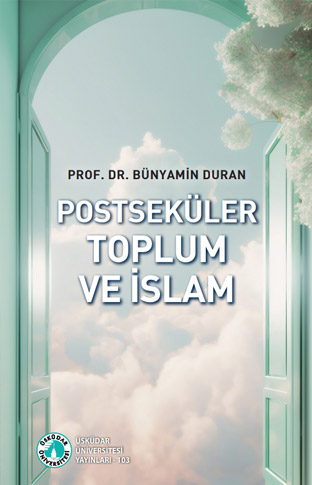
Post-Secular Society and Islam
This study is intended as a modest contribution to the debates on alienation produced by capitalistic secularization. During my time in the Netherlands, I participated as a representative of European Muslims in academic and intellectual projects related to the conception of the post-secular society. What was expected from us was to articulate the possible reactions and contributions of Muslims to the vision of a post-secular society.
Believing that my contribution at the time was insufficient, I continued to explore the various dimensions of the subject after returning to Türkiye. Through this study, I have sought to fulfill the task and responsibility of examining the project in a more comprehensive manner and of introducing an Islamic perspective to it.
In the study, I first examine the theoretical and practical framework of the secular phase by classifying it into four categories: capitalistic secularization, atheistic secularization, agnostic secularization, and liberal secularization. In the subsequent sections, under the heading of liberal secularization, which contributes to the debates on the conception of a post-secular society, I present the views of J. Rawls and Audi on the subject, along with the critiques directed at them.
In the following section, I address the views and ideas of the German philosopher Jürgen Habermas, who is considered the principal authority on the conception of the post-secular society, as well as the critiques directed toward his thoughts.
In the final section, taking into account in general terms the approaches of Said Nursi, I investigate within the framework of the Hanafi and Maturidi perspective whether it is possible to establish a constitutional democratic regime based on the principles of free and equal citizenship.
ISBN: 978-625-96402-3-5
Publication date: 2025
Edition: 1st Edition
Language: Turkish
Number of pages: 232
Publisher: Üsküdar University Press- 103