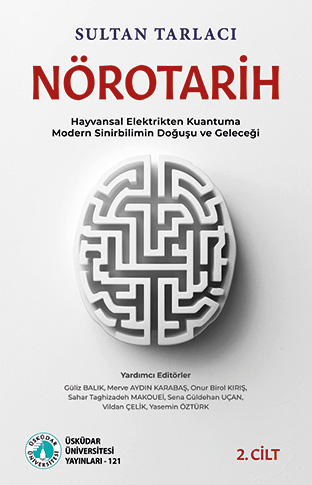
NeuroHistory II
NEUROHISTORY II
From Animal Electricity to Quantum Theory: The Birth and Future of Modern Neuroscience
If the brain is a machine, and if thoughts are nothing more than the firing of nerve cells, then what is that indescribable feeling we experience while listening to music, or the profound sense of awe we feel when gazing at a breathtaking landscape? Are these, too, merely electrochemical reactions?
The second volume of NeuroHistory focuses on the groundbreaking discoveries and intense rivalries among the scientists who sought answers to these questions at the dawn of modern neuroscience. With the development of the microscope and tissue-staining techniques in the nineteenth century, the secrets of the brain began to be revealed at the cellular level. Camillo Golgi’s invention of the "black reaction" and Santiago Ramón y Cajal’s use of this technique to demonstrate that neurons are independent units initiated one of the greatest paradigm shifts in the history of neuroscience.
From Paul Broca’s discovery of the speech center to Carl Wernicke’s identification of the brain regions involved in language comprehension; from the motor cortex stimulation experiments of Fritsch and Hitzig to David Ferrier’s efforts to map brain functions, this period illuminates the path from the decline of phrenology to the birth of modern neuropsychology. The tragic story of Phineas Gage dramatically reveals the crucial role of the frontal lobes in personality and decision-making.
Yet NeuroHistory is not only the story of discoveries, but also of the overlooked heroes who stood in their shadows. The book demonstrates that scientific progress has never followed a straight line. Some ideas, such as phrenology, profoundly influenced their era only to be abandoned over time, while others, such as the Circle of Willis and Brodmann areas, have retained their relevance for centuries.
By the twentieth century, the elucidation of the ionic basis of the action potential, the development of a mathematical model of neural transmission through the Hodgkin-Huxley equations, and the discovery of neurotransmitters revolutionized neurophysiology. Otto Loewi’s dream-inspired experiment, which provided evidence for chemical neurotransmission, remains one of the most inspiring anecdotes in the history of science. Wilder Penfield’s stimulation of the brains of awake patients during surgery, which led to the mapping of sensory and motor functions through the cortical homunculus and the triggering of vivid memories, fundamentally transformed our understanding of the brain’s mysterious inner world.
Drawing upon this rich historical legacy, NeuroHistory also casts a bold gaze toward the future. At the point where classical physics appears insufficient, it explores how quantum mechanics may provide a key to addressing some of the most complex questions surrounding consciousness and the mind, and discusses the emergence of new disciplines such as NeuroQuantology.
This two-volume work is not merely a history book. It is an epic journey into the meaning of being human, guided by science, philosophy, and curiosity. NeuroHistory is an indispensable reference for anyone seeking to uncover the secrets of the three-kilogram universe that resides within our heads.
Dr. Sultan Tarlacı
ISBN: 978-625-93668-8-3
Edition: First Edition
Language: Turkish
Pages: 374
Publisher: Üsküdar University Press - 121