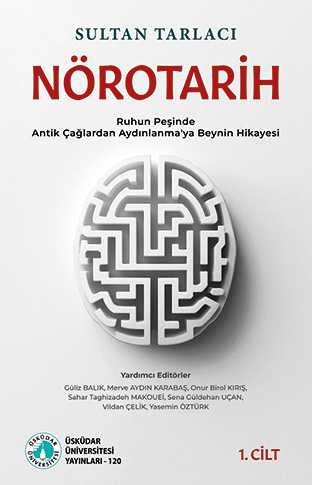
NeuroHistory I
NEUROHISTORY I
In Pursuit of the Soul: The Story of the Brain from Antiquity to the Enlightenment
How did this three-kilogram organ inside the skull become a being capable of questioning the universe, falling in love, formulating mathematical theorems, and becoming aware of its own existence?
In Ancient Egypt, embalmers carefully preserved the heart, which they regarded as the key to immortality, while extracting the brain through the nostrils with an iron hook and discarding it as waste. Thousands of years later, that same brain stood at the center of a scientific discipline, neuroscience, dedicated to understanding its own workings. NeuroHistory is the story of this extraordinary transformation.
Rather than presenting the history of neuroscience merely as the chronology of a scientific discipline, this book approaches it as a grand intellectual adventure in which philosophy, psychology, psychiatry, and even theology are deeply intertwined. This first volume spans a broad spectrum, from humanity’s earliest attempts to understand itself to the revolutionary discoveries of the nineteenth century.
The journey begins in Ancient Egypt and Mesopotamia, where the brain was not even recognized as an organ of thought. Cases of trepanation, the earliest brain surgeries performed during the Stone Age, with survival rates that would astonish even modern surgeons, reveal humanity’s ancient struggle against the unknown. We then step into the magnificent world of Ancient Greece. Following the traces of the soul in Homer’s epics, we witness how the foundations of scientific thought were laid through the mind-body and soul-brain debates of Alcmaeon, Hippocrates, Plato, and Aristotle.
In Alexandria, the bold dissections of Herophilus and Erasistratus brought the nervous system into the light of scientific inquiry for the first time, while Galen, the great physician of the Roman Empire, established a medical authority that would remain largely unquestioned for centuries. The book traces the path from Galen’s encephalocentric model to the ventricular localization theories of the Middle Ages, from the golden age of the Islamic world, where knowledge was preserved and advanced, to the unique atmosphere of the Renaissance, where art and science converged. Leonardo da Vinci’s ingenious wax-casting experiments designed to unravel the mysteries of the brain, together with Vesalius’s revolutionary corrections of Galen’s errors, herald the birth of modern anatomy.
This volume demonstrates that neuroscience is not merely a science of anatomy but also a battleground of ideas. By emphasizing that we cannot fully understand the present without understanding the past, NeuroHistory invites readers on a fascinating journey through the remarkable history of the extraordinary universe contained within our skulls.
Dr. Sultan Tarlacı
ISBN: 978-625-93668-7-6
Edition: First Edition
Language: Turkish
Pages: 492
Publisher: Üsküdar University Press - 120